

Goal setting in a growing company is hard. You have a clear vision for where you want to go, but the day-to-day pulls people in different directions. Teams get siloed. Communication breaks down. Everyone is busy, but the strategic work barely moves.
This is what OKR fixes.
Google, Netflix and Amazon have used OKR since they were small startups. In this guide I break down what OKR is, how good teams use it, how to use AI to draft them, and how to roll the framework out in your business.
Key takeaways
- The definition: OKR stands for Objectives and Key Results. It’s a goal-setting framework that connects strategy to measurable outcomes.
- The structure: a good OKR pairs one qualitative, inspiring Objective with 2 to 5 quantitative Key Results.
- The focus: OKR is about changing and growing the business, not running business as usual.
- The cadence: most teams run OKR on a 90-day cycle with brief weekly check-ins.
What is OKR? The core definition
OKR (Objectives and Key Results) is a collaborative goal-setting framework used by teams to set ambitious goals with measurable results.
It is not a to-do list. An OKR states what you are trying to achieve and how you will know you got there. It takes a slice of your overall strategy and connects the team directly to the outcome they own.
The origin story of OKR
OKR was created by Andy Grove at Intel in the late 1960s. During the microprocessor wars with Motorola, Grove needed a way to point his whole workforce in the same direction. He evolved the idea from Peter Drucker’s Management by Objectives, with a sharper focus on measurable execution.
John Doerr worked under Grove at Intel before moving into venture capital. In 1999, he pitched OKR to the founders of a young startup called Google. They adopted it on the spot. It still runs their operating rhythm today.
Most of the businesses we work with adopt OKR for one reason. It gives them focus they did not have before. In our State of OKR Report, 100% of the businesses using the framework said it helped them deliver tangible outcomes.
The anatomy of an OKR
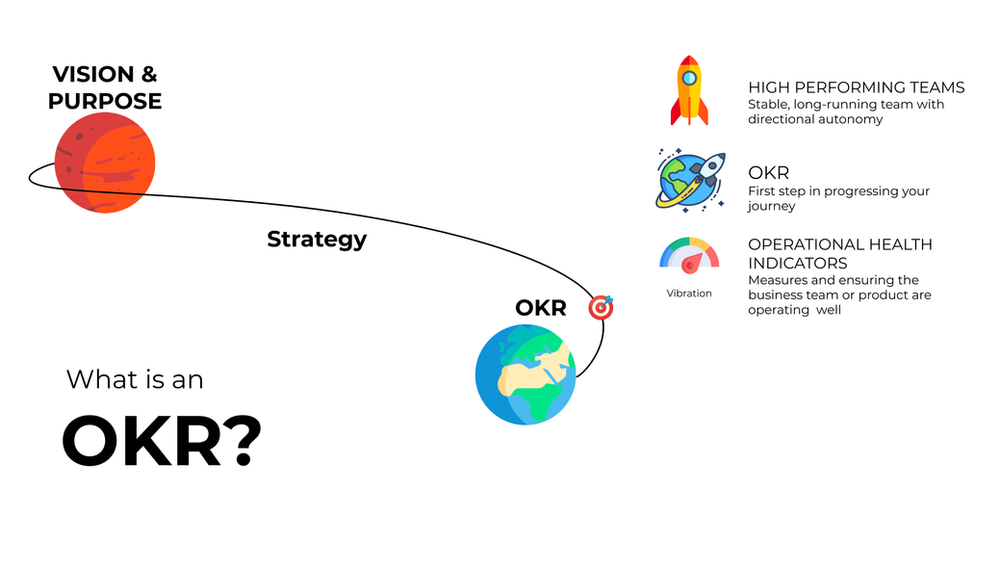
Think of your long-term strategy as your destination. Your OKR is the next milestone on the way there. An OKR has two parts: the Objective and the Key Results.
1. What is an Objective?
An Objective is a clear, inspiring statement of the problem you want to solve in the next quarter. It sets direction. It answers the question: where are we going?
Rules for a strong Objective:
-
Make it qualitative and inspiring. It should read like a bold headline that gives the team something to rally behind.
-
Keep it time-boxed. Usually one quarter, 90 days. If the problem takes a year to solve, narrow the scope to what you can realistically do this quarter.
-
Have one. Ideally one Objective per team. Focus means saying no to the ten other good ideas. Five Objectives is no Objectives, it’s just a task list.
2. What are Key Results?
Key Results measure progress toward the Objective. They answer the question: how will we know we got there? The most common mistake is treating Key Results like a project plan. “Launch the new website” is an output, not an outcome.
Rules for a good Key Result:
-
Make it quantitative. It must contain a number. You can’t argue with a number at the end of the quarter.
-
Limit the quantity. 2 to 5 per Objective. More than that dilutes focus.
-
Measure outcome, not output. A good Key Result measures the impact of the work. Instead of “Launch the app update,” try “Increase Daily Active Users from 2,000 to 3,000.”
-
Use a baseline-to-target formula. The clearest format is “Increase/Decrease [metric] from [baseline] to [target].” Baseline and target, every time.
OKR vs KPI: understanding the difference
If you already track metrics, you might be wondering how OKR differs from KPI. This is the most common point of confusion on executive teams.
Both measure success, but they do different jobs. KPI measures the health of the business. OKR measures the change in the business.
| Feature | OKR (Objectives & Key Results) | KPI (Key Performance Indicator) |
|---|---|---|
| Primary focus | Driving change and strategic growth. | Maintaining business as usual and operational health. |
| Timeframe | Temporary and time-bound (e.g., 90-day cycles). | Continuous and ongoing (e.g., tracked indefinitely). |
| Nature of goal | Ambitious. 70% achievement is considered great. | Realistic, steady targets. 100% compliance is expected. |
| Example | Increase trial-to-paid conversion from 10% to 15%. | Maintain website server uptime at 99.9%. |
Think of KPI as the dashboard in your car. Fuel, oil, engine temperature. It tells you whether you’ll break down on the highway. OKR is the GPS. It guides you to a new destination. You need both. Don’t confuse them.
The benefits of OKR
When OKR is implemented well, it changes how a team operates. Moving from annual planning to a quarterly OKR rhythm gives you four things:
-
Direction with autonomy. OKR bridges executive strategy and frontline execution. Teams decide how to solve the problem, as long as they hit the Key Results.
-
Real alignment. When goals are transparent across the business, cross-functional teams can co-ordinate. When Sales knows what Product is prioritising this quarter, work stops colliding.
-
Leading indicators. Financial metrics are lagging. They tell you what happened last quarter. OKR is a leading indicator. If you’re heading the wrong way, your Key Results tell you early, while you can still course-correct.
-
An outcome mindset. When people focus on impact instead of activity, low-value busywork gets cut. Culture shifts from “what did you do today?” to “what did you change today?”

How to use AI to draft your OKR
The hardest part of adopting OKR for most teams is staring at a blank page. Writing good OKR takes practice. Modern AI tools like ChatGPT and Claude are excellent at turning a messy business problem into a clean OKR draft.
To get useful output, give the AI context, a role to play, and formatting constraints.
The master OKR prompt
Copy and paste this prompt, filling in the bracketed details:
“Act as an expert OKR coach and business strategist. My team is responsible for [team’s focus]. Our biggest strategic bottleneck right now is [the problem].
Based on this, write 3 options for a quarterly OKR. For each option:
1. Provide one inspiring, qualitative Objective.
2. Provide 3 quantitative Key Results that measure outcomes, not outputs. Use the formula ‘Increase/Decrease [metric] from [baseline] to [target]’.
3. Suggest 3 potential initiatives (tasks or projects) we could run to move the Key Results.”
If you ask AI to “write sales goals,” it’ll give you generic tasks. The prompt above shifts AI from outputs to outcomes.
Resource: to skip the trial and error of prompt engineering, you can access our complete AI Prompt OKR Generator Guide, which includes tested prompts for every scenario, from scaling revenue to improving team culture.
Using AI to write better OKR
AI can help you write sharper OKR, but only if you give it the right context. A generic prompt gets a generic OKR. The output is only as good as the input.
To make this easier, we built Telos, an AI OKR coaching agent trained on the OKR Quickstart methodology. You give it your team’s situation, the problem you’re trying to solve, and your current metrics. It helps you move from vague Objectives and activity-based Key Results to goals that actually measure outcomes. It calls out vanity metrics, challenges output thinking, and helps you find the right problem before you commit to a goal.
Download the Telos prompt set here.
For a practical guide on using AI in your OKR process, including what to prompt, what to avoid, and examples you can use straight away, read the full guide here.
Department-specific OKR examples
To see how OKR applies across an organisation, here’s how different departments translate strategy into OKR.
Sales and revenue OKR
Sales naturally lives in numbers, but OKR helps the team focus on pipeline quality and efficiency, not just raw quota.
Objective: Accelerate our enterprise sales motion to win the mid-market sector.
- Key Result 1: Increase average deal size from $15,000 to $25,000.
- Key Result 2: Decrease average sales cycle length from 65 days to 45 days.
- Key Result 3: Increase the win rate of enterprise-qualified leads from 18% to 25%.
Marketing OKR
Marketing teams often get trapped in output metrics (number of posts, number of campaigns). OKR forces a focus on pipeline contribution and brand impact.
Objective: Turn our inbound website traffic into a high-converting revenue engine.
- Key Result 1: Increase organic blog traffic from 10,000 to 25,000 unique monthly visitors.
- Key Result 2: Improve lead-to-MQL (Marketing Qualified Lead) conversion rate from 4% to 8%.
- Key Result 3: Reduce Customer Acquisition Cost (CAC) on paid social channels from $120 to $90.
Engineering and product OKR
For technical teams, OKR closes the gap between writing code and delivering user value.
Objective: Deliver a clean, fast onboarding experience for new users.
- Key Result 1: Decrease the average time to complete account setup from 5 minutes to 90 seconds.
- Key Result 2: Reduce critical onboarding bug reports from 15 per week to 0.
- Key Result 3: Increase Day-7 user retention rate from 40% to 60%.
HR and leadership OKR
People and culture metrics are notoriously hard to track, but OKR gives you a structured way to measure human impact.
Objective: Build high-impact, confident leaders across the business.
- Key Result 1: Increase the percentage of leaders who feel equipped with the right management tools from 50% to 100%.
- Key Result 2: Improve team member survey scores on “managers help set clear goals” from a median of 2.0 to 4.0.
- Key Result 3: Increase internal promotion rate from 10% to 25%.
Resource: need more inspiration for your team? Read our Best OKR Examples guide, with over 50 real-world examples you can adapt to your business.
The first 90 days: a step-by-step rollout blueprint
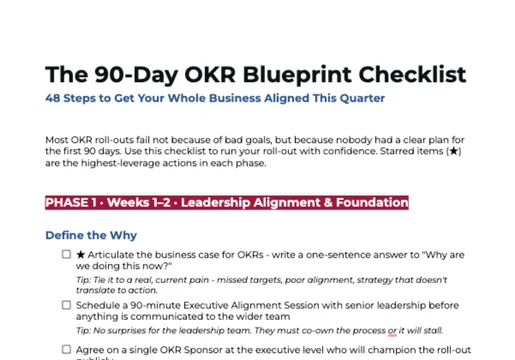
Rolling out OKR is a change management project. If you dump a new framework on the team on a Friday afternoon, it’ll be dead by Monday. Here is the 90-day blueprint we use.
Weeks 1-2: executive alignment
Before you present OKR to the wider team, leadership has to be aligned on why this change is happening.
-
Define the why. Be clear about the problem OKR is solving (poor communication, missed deadlines, lack of focus).
-
Draft the top-level OKR. Leadership drafts one company OKR. Every team OKR sits underneath this.
-
Pick champions. Identify a few influential, organised team members to facilitate the rollout on the ground.
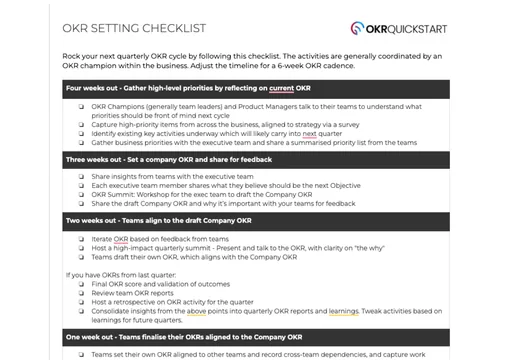
Resource: to save hours of prep, use our OKR Rollout Presentation Deck to explain the value and mechanics of the framework to executives and champions. Pair it with our OKR Setting Checklist so the coordinator running the cycle has a week-by-week timeline of what to do, from four weeks out to launch.
Weeks 3-4: the team workshop
This is where the work happens. Book a 3-hour workshop with each team to draft their first goals.
-
Pre-work. Ask people to come prepared with their view of the biggest bottlenecks.
-
Drafting. Debate the problems, agree on one Objective, agree on 2 to 5 Key Results.
-
Initiatives. Brainstorm the actual projects you’ll run to move the Key Results.
Resource: keep the workshop on track with our OKR Facilitation Kit, a full set of prompts, agendas and structure to run a killer OKR workshop and walk out with goals the team will actually own.
Weeks 5-12: the weekly operating rhythm
This is the most critical phase. An OKR is only as good as the routine that supports it.
-
The 15-minute weekly check-in. Each week, the team reviews the OKR. Don’t use this time for standard status updates. Only discuss work that directly affects the Key Results.
-
Confidence scoring. Ask, “on a scale of 1 to 10, how confident are we that we’ll hit this Key Result by the end of the quarter?” If the score drops, surface blockers immediately.
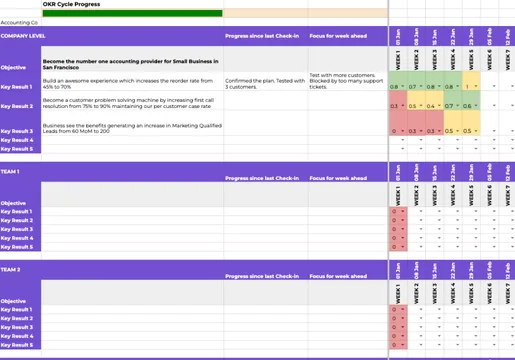
Resource: to run these check-ins, download our OKR Confidence Scoring and Tracking Templates (Google Sheets and Excel) to track weekly progress across the company OKR and every team OKR underneath it.
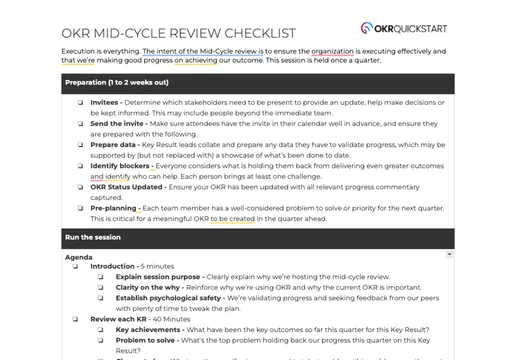
For quarterly mid-cycle reviews, use our Mid-Cycle Review Checklist to run a focused session at the half-way point and course-correct before the quarter is over.
OKR anti-patterns: why teams fail
We’ve implemented OKR in hundreds of organisations. When it fails to stick, it is almost always one of these patterns.
-
Set it and forget it. Teams spend hours crafting perfect OKR in a spreadsheet, close the document, and don’t look at it again until the end of the quarter. By then, it’s too late. OKR has to live in your weekly team meeting.
-
OKR tied to compensation. This is fatal. If a person’s bonus depends on hitting a Key Result, they’ll lower the target to make sure they hit 100%. OKR is meant to encourage ambition. Tie performance reviews and OKR loosely, not directly.
-
Everything is an OKR. If you turn every task, maintenance duty, and business-as-usual activity into an OKR, the framework collapses under its own weight. OKR is about strategic focus, not a complete inventory of all work.
-
Tasks disguised as Key Results. If you can complete it in an afternoon, it’s an initiative, not a Key Result. If you measure output instead of outcome, you are missing the core value of the framework.
How to score and grade OKR
At the end of the 90-day cycle, you grade your performance. This is a moment for honest reflection, not subjective judgment.
Google grades Key Results on a 0.0 to 1.0 scale. We recommend the same:
-
0.7 to 1.0 (green, success): you delivered. In the OKR philosophy, consistently hitting 70% of an ambitious stretch goal is a real win. It means you pushed the team hard and achieved real growth. If you easily hit 1.0 on every Key Result, your goals weren’t ambitious enough.
-
0.4 to 0.6 (yellow, partial success): you made meaningful progress, but fell short. This is the time to analyse the bottlenecks. Did you lack resources? Did priorities shift mid-quarter?
-
0.0 to 0.3 (red, failure to launch): you didn’t move the needle. Don’t punish the team. Use it as a learning moment. Was the Key Result impossible to measure? Was it the wrong goal? Adjust your strategy for next quarter.
Your next steps and resources
Moving your team to an outcome-based framework takes time and the right tools. You do not have to build your process from scratch.
We’ve bundled our most road-tested resources into a single kit to help you implement OKR cleanly.
Download the Free OKR Master Kit, which includes:
- The AI Prompt OKR Generator Guide: draft your goals instantly.
- 50+ OKR examples in our Best OKR Examples guide: templates for every function.
- The 90-Day OKR Blueprint Checklist: the full 48-step plan to align the business this quarter.
- The OKR Setting Checklist: week-by-week activities for the coordinator running the cycle.
- The OKR Facilitation Kit: everything you need to run a great team OKR workshop.
- The OKR Confidence Scoring & Tracking Templates: track weekly progress at company and team level.
- The Mid-Cycle Review Checklist: run a focused half-way session and course-correct.
Download Your Free OKR Master Kit Here
We work with leaders who want to scale their business and build high-performing, resilient teams. If you want to skip the trial and error and get your organisation moving in a few weeks, book a free OKR Strategy Call with Tim today.