

When it comes to the management of an organization or a business, there are two very distinct features that need to be kept in mind when it comes down to the details. One is about maintaining a healthy business, the other is about growth.
Summary:
- You run the business with KPI and you change the business with OKR.
- OKR is a popular goal setting framework used by the world’s leading tech firms, such as Amazon, Google and LinkedIn.
- OKR uses Key Results for metrics, which include the measure at the start of the goal setting period (so you know where you’ve started) and a target for the end.
- OKR is about stretching for success, so typically 70% achievement is considered successful.
- KPI is simply a measurement that you use to track the health of the business.
- KPIs have a metric that sets a healthy range for where the measure is considered acceptable. If it falls out of this range, then action must be taken.
Two very important performance tools that are used to monitor and evaluate the efficiency and effectiveness of business tasks are called KPIs and OKRs.
Understanding OKR and KPIs
KPIs or Key Performance Indicators are often compared to OKR or Objectives and Key Results. The two have overlapping qualities, but they do different jobs.
The difference in a nutshell:
- OKR is about creating change: To grow as a business, you need to set and achieve audacious goals. This creates focus for your teams and encourages them to strive for the incredible. The OKR framework encourages experimentation and innovation by changing the business for the better. It creates focus on key measures which align teams both vertically with the leadership team and horizontally between teams.
- KPI is about business health: While we’re driving growth we need to make sure the business is running well and no underlying issues are bubbling up. This is where KPIs come in. They tell us that the business is running within a sustainable range. Rather than focus, they identify measures we must be aware of. Focus is only required where the measure is heading away from its desired state.
OKR vs KPI at a glance
| OKR | KPI | |
|---|---|---|
| What it’s for | Driving change against a strategic priority | Monitoring the health of business as usual |
| Time horizon | 6 weeks to a quarter, sometimes paired with an annual goal | Continuous and ongoing |
| Type of goal | Ambitious. 70% achievement is considered great. | Realistic target or healthy range. 100% compliance is expected. |
| Metric style | Outcome metric moved “from X to Y” | Single number kept inside a healthy range |
| Cadence of conversation | Weekly check-in plus end-of-cycle score | Reviewed when the metric drifts out of range |
| Transparency | Open across the organisation | Often held inside the team or function |
| Example | Increase trial-to-paid conversion from 10% to 25% | Maintain website uptime at 99.9% |
The short version: you run the business with KPI, you change the business with OKR. Most teams need both.
What is OKR and what are its components?
Objective and Key Results is a strategic management framework. It connects teams to the vision and takes a valuable slice out of the Business Strategy. If your strategy is any good, this means you need to change. Possibly through better services, products or experiences.
This positive change can be captured by the objective of what we want. To actually measure and verify that we achieved this objective, we need measurable key results. So whatever our metric is doing today, we’ll want to see that move. This is where OKRs are different from KPIs. They create focus on moving a metric, not just maintaining it. Here, we’re going from an existing state to the new state for our OKR:
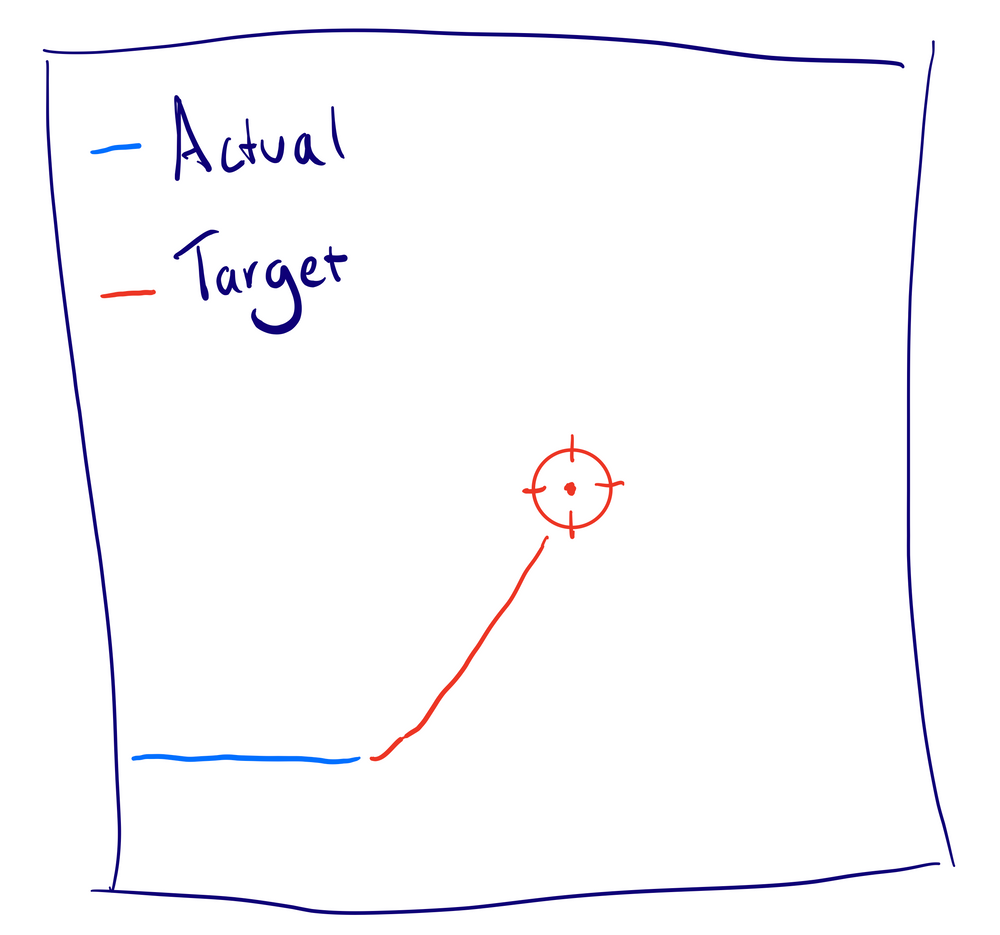
Here’s an example, a marketing team may have the following OKR to create improvements in their current performance.
Pro tip: Write your Key Results like this. It creates clarity on the current score and how far the needle actually needs to move.
Objective: Become the top ticketing product for small HR tech businesses
Key Result 1: Increase HR tech small business segment social re-shares from 10% of posts to 60%
Key Result 2: Increase Marketing Qualified Leads from 100 MoM to 1,000 with no negative impact to sales conversion rate
Key Result 3: Increase social response speed from 1 day down to 2 hours
This example shows how we need to stretch to achieve and showcases how to create leading indicators. These leading indicators will tell us we’re heading down the right path and making progress. If we’re off track, it gives us the platform to pivot what we’re doing in order to achieve the outcome. This contrasts with KPIs which while generally not leading, they reflect hard data that we might need to track. We would hope that by achieving the OKR above, our lagging indicators like sales will improve.
OKRs need to be ambitious because easily achieving objectives means that the goal was not aggressive enough. The Key Results are therefore a stretch. We score the success of each Key Result on a scale of 0 to 1. We create this stretch by considering success as a score of 0.7 across each Key Result. Any higher than that, you’re sandbagging. Any lower, and you probably didn’t try hard enough.
This framework is especially popular with the largest companies on earth like Google and Amazon. They are often big-picture goals and have a designed target that requires a push from employees to put the company forward. OKRs are therefore all about change.
A tip we have is not to build OKRs in a state of a vacuum without visibility on the integral parts of a business. The best way to build these is by using a pyramid structure, wherein the foundation starts at the employee level and works its way up and setting achievements for each level. OKRs are best utilized for growth goals that are over the top, and not for organizations looking for slow and steady growth.
More OKR Examples
Let’s look at some more OKR examples:
Objective: Improve Employee Engagement and Retention
- Key Result 1: Increase employee engagement score from 70 to 85
- Key Result 2: Reduce annual employee turnover rate from 15% to 10%
Objective: Have our customers fall back in love with our product
- Key Result 1: Increase customer satisfaction score from 70 to 90
- Key Result 2: Reduce average first response time from 24 hours to 12 hours
- Key Result 3: Increase customer retention rate of from 85% to 95%
Objective: Increase Brand Awareness in the US Market
- Key Result 1: Lift branded-search volume in the US from 4,800/month to 9,000/month
- Key Result 2: Increase US organic website traffic from 50,000 to 100,000 visitors per month
- Key Result 3: Lift share of new MQLs sourced from earned media from 6% to 18%
(Note: a “grow social followers” KR is the classic vanity-metric trap. Counts that look good without correlating to pipeline. Branded-search volume and earned-media-sourced MQLs are better proxies for actual awareness.)
What is a KPI and what are its components?
Key performance indicators are a tool utilized to evaluate the health of an organization, program, project, action, or individual. These indicators normally link to strategic objectives, show where to redirect focus, and create a comparison to other points in time.
These can be found in almost any industry, which is used to evaluate progress and successfully reach goals. Provided you are not a small company, KPIs should be done by department or by industry for larger conglomerates. Some examples of KPI tests for different industries and divisions would be how the retail industry can utilize revenue per square foot, sales per employee, and same-store sales. These can be used to show how well the division is performing, and can, therefore, draw trends and conclusions based on data.
KPIs must be measurable, with quantitative values that make it easier to provide context and make performance better by comparing these with other variables. Qualitative KPIs are not advisable because of how they make data interpretations subjective, so make sure they are always measurable using numbers and values.
We are happy as long as the measure is within a certain healthy range. It’s normal for minor adjustments to be made in order to maintain a healthy KPI.
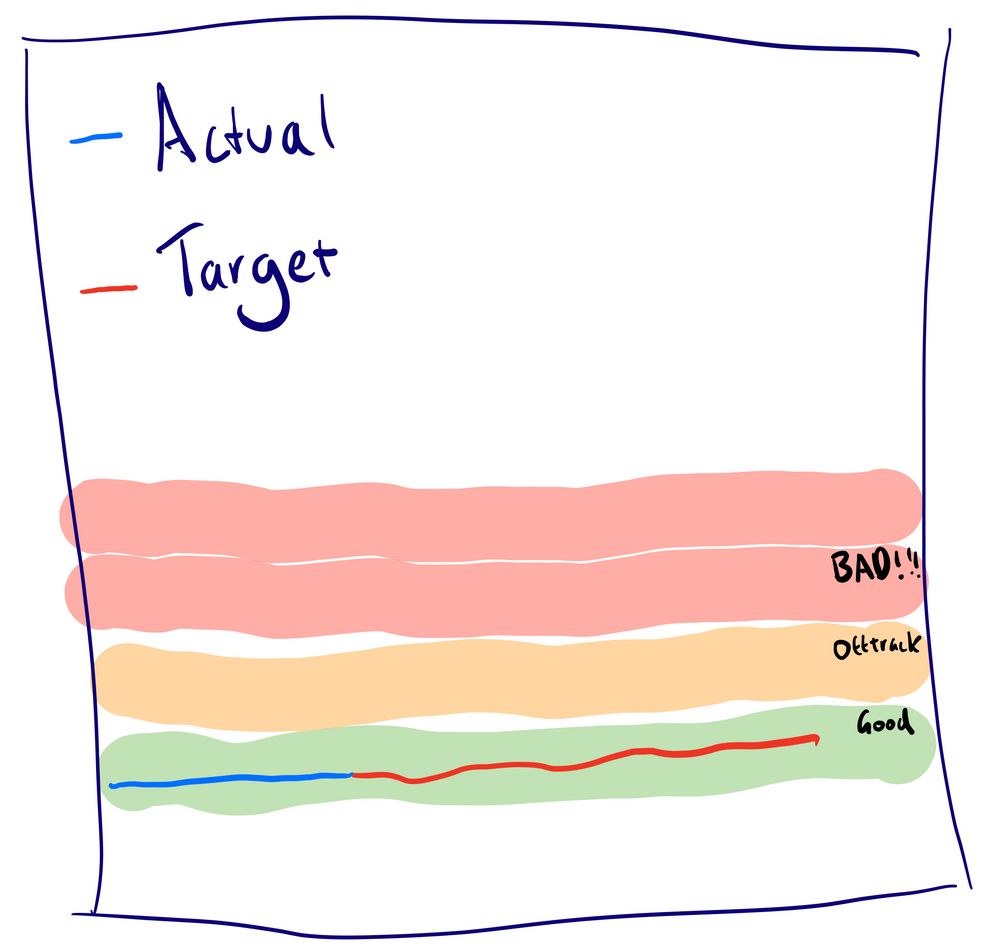
If things have really gone south, sometimes we need to turn a KPI into an OKR. The usual rules apply here. We want good quality OKRs which consists of leading metrics. Where the KPI is a leading indicator, we can include it as is within our OKR. If it’s a lagging indicator, then you’ll need to have a think about what metrics are a good predictor of change for this KPI.
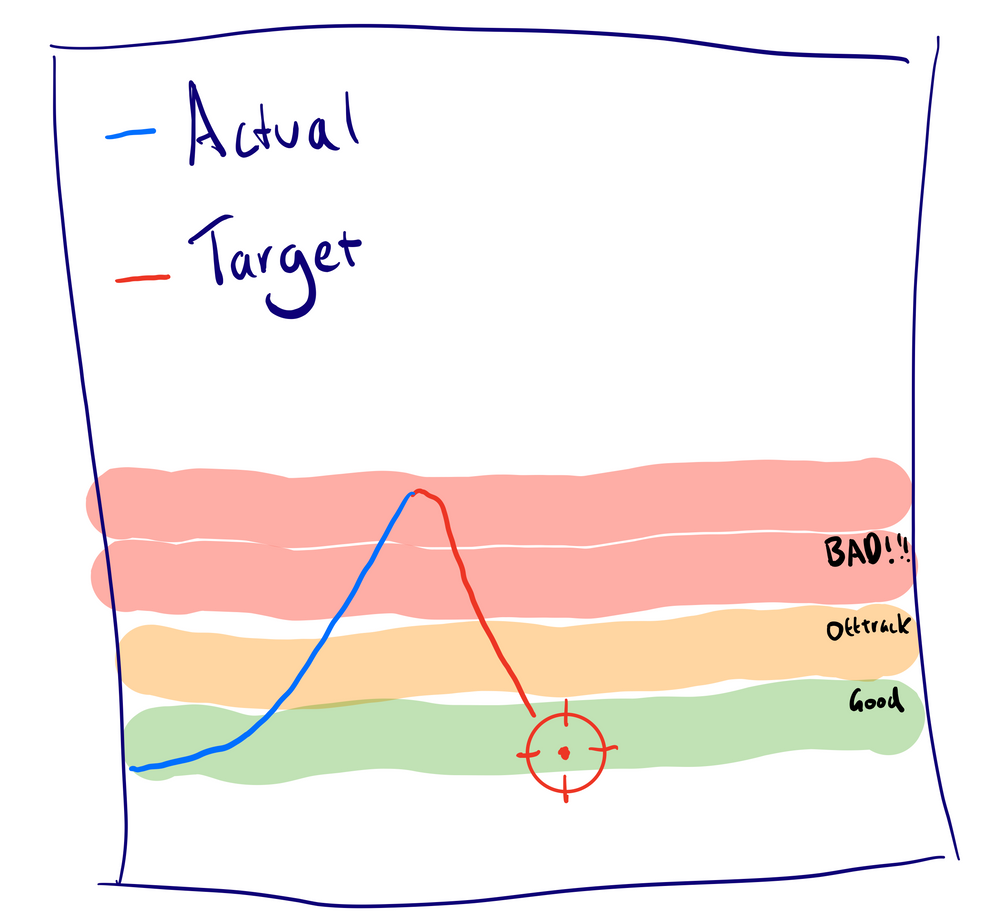
When it comes to creating KPIs, make sure everything is defined and determined clearly. Vagueness does not help, so create a context for each KPI by tying it to an objective and compare it to targets set by your industry. Remember that the keyword from the term “KPI” is “key”, so track the necessary data that gives the biggest impact and has value to the company.
KPI Examples
Some good KPI examples include:
- Quarterly revenue target: Achieve a quarterly revenue of $500,000 to $600,000.
- Average transaction value: Maintain an average transaction value of $100 to $150.
- Customer retention rate: Retain 90% of existing customers each quarter.
- Customer acquisition cost (CAC): Keep CAC at $50 to $70 per new customer.
- Order fulfilment time: Complete order fulfilment within 24 hours.
Choosing between OKR and KPI for your organisation
It’s not really an either or. To grow a business and run it well, you need both.
OKR is ideal for driving change and hitting ambitious targets. KPI helps you maintain and monitor ongoing performance. For startups and growth-focused companies, OKR provides the push needed for rapid expansion. KPI, on the other hand, is valuable for more established businesses that need stability and consistency.
Factors to consider
- Organisational goals: What are your strategic priorities? Growth, stability, or both?
- Company size: Smaller companies tend to benefit more from the dynamic nature of OKR. Larger organisations rely more on KPI to keep consistency across departments.
- Industry requirements: Some industries need specific KPIs to meet regulatory standards or customer expectations.
Integrating OKR and KPI in a business strategy
To get the best of both worlds, integrate both OKRs and KPIs into your business strategy. Use OKRs to push the boundaries and drive significant changes, while KPIs help you track the health and performance of existing operations. By integrating both, you create a dynamic yet stable environment that encourages innovation without losing sight of operational excellence.
To make both OKR and KPI work, you need alignment across every level of the organisation. That means clear communication of progress, regular reviews, and the discipline to adjust when reality moves away from the plan.
I like to track progress by checking in on our OKR weekly. I’ve outlined how you do it in my OKR Tracking article. In short, you want to discuss both KPIs (health metrics) and OKR (the change you’re driving).
When tracking your KPIs, we only want to focus on metrics which are off track. When it comes to OKR, we want to discuss progress, next steps and score our confidence.
Conclusion
The clear difference between the two methods is the urgency of growth. While KPIs give a company a clear-cut view on health and what makes their performance top-tier, OKRs are for targeting dynamic and dramatic growth. Both tools should be utilized if you plan to grow your business to the next level, but consider the uses of each and if they apply to the goals set by you.
Let’s get you started with OKR
Your first time setting OKR can be pretty tricky. My aim with OKR Quickstart is to make this easier and more accessible for all.
Here’s a few ways you can make your OKR journey easier and more successful:
- Explore our OKR Training Courses (includes free training),
- Grab my OKR templates to kickstart your OKR journey,
- Jump on a call with me to discuss the best way to start, or check out my OKR Services if you’re just exploring.